🌍 EU Spice Sourcing Is Becoming More Detail-Oriented
EU spice sourcing has changed significantly over the last few years.
Earlier, many buying decisions were driven mainly by:
- price
- appearance
- basic specification matching
Today, sourcing discussions are becoming much more detailed.
Importers evaluating products such as Cuminum cyminum L. (cumin seeds), Plantago ovata Forssk (ispaghula / psyllium seeds), Nigella sativa L. (black cumin / kalonji), and Anethum graveolens L. (dill seeds) increasingly look beyond the specification sheet itself.
The focus is often broader:
- residue management
- microbiological expectations
- process declarations
- shipment stability
- traceability
- sourcing consistency
Because in regulated markets, a compliant sample does not always guarantee a compliant shipment.
We explored this broader shift in EU spice compliance expectations in detail in our article on
Why Many Spice Shipments Struggle with EU Compliance — And How Experienced Buyers Mitigate Risk
EU compliance is no longer evaluated only at the sample stage.
It is evaluated across the entire shipment cycle.
🔎 Specifications Are Important — But They Are Not the Entire Picture
For many spice categories, specifications may include:
- pesticide residue requirements
- microbiological limits
- contaminant thresholds
- processing declarations
- moisture and purity standards
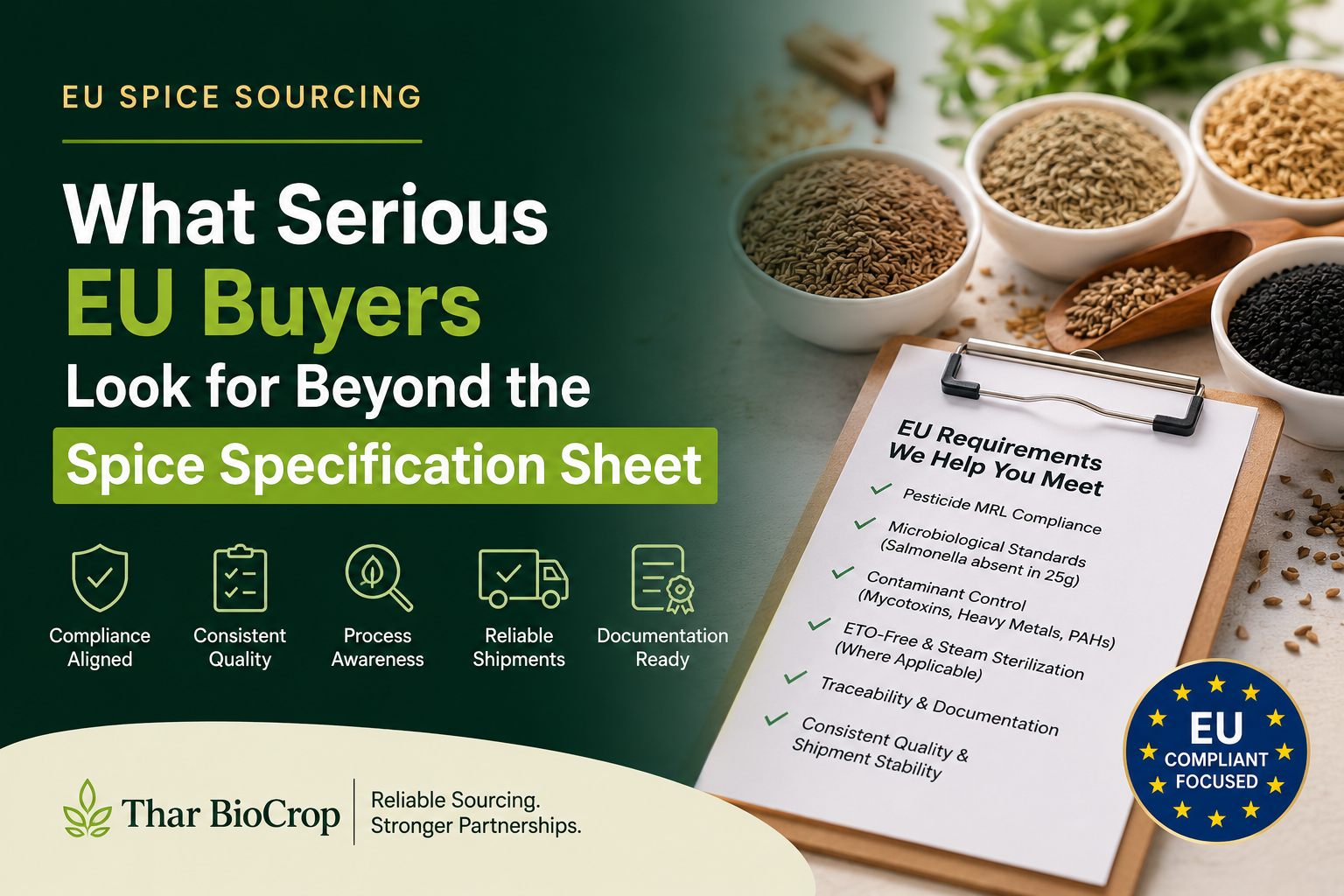
EU buyers also frequently evaluate microbiological expectations such as Salmonella absent in 25g, especially in higher-risk categories.
These expectations continue to evolve under frameworks guided by the
European Food Safety Authority (EFSA)
As a result, buyers often evaluate not only whether a product meets a parameter, but also whether the sourcing and handling approach behind it appears stable and reliable.
⚠️ Why Buyers Often Look Beyond the Main Parameter
Every spice category has a few headline parameters.
But experienced sourcing teams usually evaluate surrounding indicators as well.
For example:
- In Plantago ovata Forssk, swelling index is often closely monitored because it directly affects functional performance
- In Cuminum cyminum L. and Anethum graveolens L., volatile oil retention may indicate freshness, aroma stability, and handling quality
- In Nigella sativa L., very low extraneous matter and foreign matter levels can reflect stronger sorting and cleaning practices
Parameters such as acid insoluble ash may also provide insight into cleaning quality and handling standards across spice categories.
These parameters may seem highly technical.
But in practice, they often help buyers assess sourcing consistency and shipment reliability.
🧪 Process Declarations Are Receiving Greater Attention
Across EU spice imports, processing declarations are becoming increasingly important.
This may include:
- ETO-free declarations
- sterilization methods
- fumigation practices
- allergen-related considerations
- contamination prevention approaches
For example, many EU buyers today prefer:
- steam sterilized products
- phosphine-only fumigation practices in sensitive categories
In many cases, sourcing teams evaluate not only the final laboratory result, but also whether the declared process aligns with buyer expectations and destination-market requirements.
⚠️ Residues and Contaminants Continue to Shape Sourcing Decisions
EU regulations continue to become more detailed around:
- pesticide residues
- mycotoxins
- PAHs
- heavy metals
- alkaloids
For example:
- Ochratoxin A limits are closely monitored across multiple spice categories
- Psyllium categories may also involve monitoring for tropane alkaloids and pyrrolizidine alkaloids
As a result, many importers now evaluate sourcing reliability and supplier alignment more carefully than before.
📦 Shipment Stability Is Becoming Increasingly Important
One compliant lot is important.
But buyers also evaluate whether:
- quality remains stable across shipments
- handling practices are consistent
- documentation aligns correctly
- sourcing remains repeatable over time
In practical terms, shipment challenges sometimes arise not from a failed parameter itself, but from:
- inconsistency between batches
- moisture stability variation
- storage fluctuations
- documentation gaps
- process-declaration mismatches
This is one reason why sourcing discussions in EU markets are becoming increasingly detail-oriented.
🌱 A Practical Perspective on EU Spice Sourcing
At Thar BioCrop, our focus is on understanding buyer requirements carefully and aligning sourcing accordingly across spice categories.
This includes attention to:
- EU-oriented specifications
- sourcing consistency
- shipment coordination
- process-related expectations
- practical compliance considerations in regulated markets
👉 These expectations continue to evolve under frameworks linked to
EU pesticide residue regulations for food products
The objective is straightforward:
Better alignment.
Reliable execution.
Long-term business relationships.
⭐ Closing Perspective
As EU sourcing expectations continue to evolve, spice procurement is increasingly becoming a discussion around alignment, consistency, and operational reliability — not simply specification matching alone.
For many buyers, the focus today is not only on whether a product passes one test report, but whether the overall sourcing approach appears dependable over the long term.
❓ Frequently Asked Questions
What is EU spice compliance?
EU spice compliance refers to alignment with European regulations related to pesticide residues, microbiological safety, contaminants, processing methods, labeling, and traceability for imported spice products.
Why are spice shipments rejected in Europe?
Common reasons include pesticide residue non-compliance, microbiological issues, contamination risks, incorrect process declarations, and inconsistencies between shipment documentation and actual product handling.
What are EU MRL regulations for spices?
EU MRL regulations define the maximum permitted pesticide residue levels in food products, including spices, under Regulation (EC) 396/2005 and subsequent amendments.
Why is ETO-free processing important in spice exports?
Ethylene oxide (ETO) treatment is heavily restricted in EU food imports. As a result, many buyers prefer ETO-free spices processed using accepted alternatives such as steam sterilization.
🤝 Connect With Thar BioCrop
If you are evaluating sourcing options for EU markets and would like to discuss specifications, sourcing alignment, or shipment planning across spice categories, our team would be glad to connect.