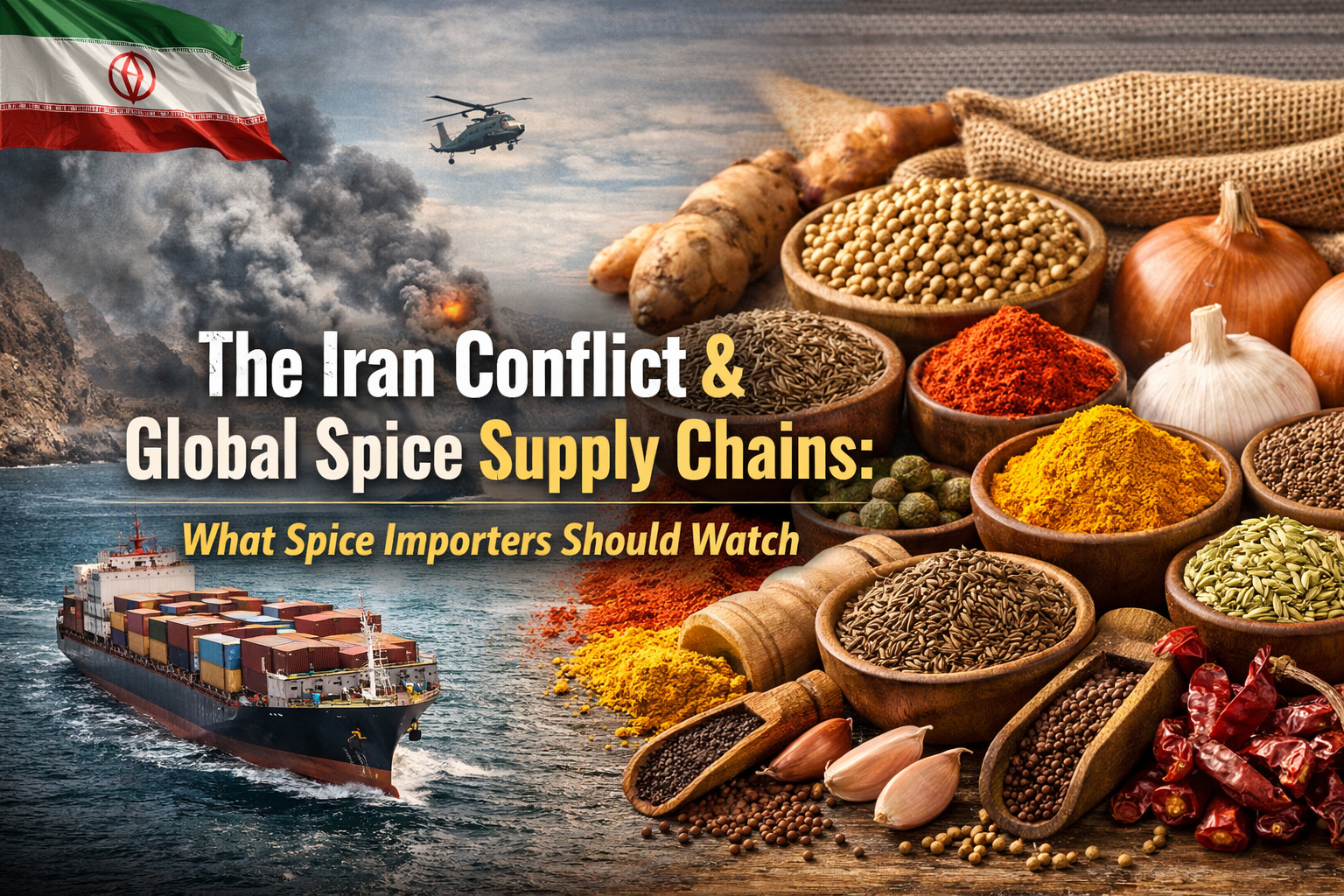
Geopolitical tensions rarely stop global food trade. But they can influence how bulk spice imports and global sourcing from Indian spice exporters are managed.
The current conflict involving Iran has raised concerns across global commodity markets. Energy prices, freight rates, and shipping insurance are reacting quickly. For companies involved in spice import, food ingredient sourcing, and global procurement, the real question is not the headlines.
It is supply chain reliability.
Where could disruption appear?
Which sourcing routes remain stable?
Understanding this helps importers manage spice supply chain risk, freight volatility, and supplier diversification.
Where the Conflict Actually Matters: Global Shipping Lanes
The primary trade concern in the region is the Strait of Hormuz.
This narrow maritime passage connects the Persian Gulf with the Arabian Sea and carries a significant share of global energy shipments. When tensions rise in the region, several supply-chain reactions typically follow:
• fuel prices increase
• marine insurance premiums rise
• shipping companies adjust routes or schedules
These factors influence container freight costs, shipping timelines, and cargo insurance, affecting many commodities including spices.
However, the actual impact on spice trade depends largely on how supply chains are structured.
When Intermediary Trading Hubs Add Complexity
In global spice trade, products do not always move directly from origin to importer.
Many shipments pass through trading hubs such as Dubai, Sharjah, or Istanbul before reaching their final markets.
A typical structure can look like this:
Origin country → Gulf trading hub → Africa, Eastern Europe, or Central Asia
These hubs play an important role in global food trade. But during geopolitical uncertainty, additional layers can introduce variables such as:
• tighter trade financing
• higher insurance costs
• additional intermediary margins
• slower coordination between trading partners
Trade usually continues. But supply chains become more layered and less predictable.
Regions Where Direct Sourcing from India Already Makes Commercial Sense
In several markets, importers already source spices directly from producing countries. During periods of geopolitical uncertainty, these supply chains often remain more stable.
West Africa
Markets such as Abidjan, Dakar, and Lagos import large volumes of spices including turmeric, cumin, coriander, and chilli.
Historically, part of this trade flows through Gulf intermediaries. However, direct sourcing from India can provide:
• clearer pricing structures
• fewer intermediary layers
• improved shipment visibility
For importers managing bulk spice procurement, this often simplifies sourcing operations.
Latin America
Countries such as Brazil and Argentina import spices directly from producing regions.
Typical shipping routes connect Indian ports with Atlantic trade lanes. These routes operate largely independent of Gulf redistribution hubs.
This structure keeps supply chains comparatively insulated from geopolitical developments in the Middle East.
North America: United States and Canada
The United States and Canada are among the largest spice import markets globally.
A large portion of spices sold in these markets are sourced directly from producing countries such as India.
Importers in these regions typically prioritize:
• food safety compliance
• traceability in the spice supply chain
• residue monitoring and laboratory testing
• consistent product specifications
These regulatory frameworks are overseen by authorities such as the U.S. Food and Drug Administration (FDA) and the Canadian Food Inspection Agency.
India’s Role as a Primary Origin for Global Spices
India remains one of the most diversified spice-producing countries in the world. For international buyers, it functions as a multi-commodity sourcing origin.
Major Indian spices widely traded in global markets include:
cumin, coriander, fennel, fenugreek, mustard seeds, turmeric, chilli, garlic, and onion.
Seed spices such as cumin and coriander are widely used in seasoning blends, spice processing, and food manufacturing across North America, Europe, Africa, and Latin America.
India is also a leading origin for turmeric and chilli, essential ingredients for color, flavor, and spice processing industries.
In addition, India exports large volumes of dehydrated garlic and onion, widely used in snack foods, ready meals, seasoning blends, and processed food manufacturing.
For procurement teams managing multiple spice categories, sourcing from India allows buyers to consolidate seed spices, color spices, and dehydrated ingredients within one origin ecosystem.
For buyers evaluating specific commodities, we have outlined sourcing considerations in detail here:
👉 Learn more about importing bulk spices from India including cumin, coriander, fennel and fenugreek.
What Importers Should Evaluate During Geopolitical Uncertainty
Rather than reacting to headlines, experienced procurement teams usually review a few operational factors.
Supply Chain Structure
Does the sourcing model depend heavily on intermediary trading hubs?
Direct sourcing from origin countries can reduce complexity.
Freight Exposure
Are shipments contracted under FOB or CIF terms?
Freight volatility directly influences landed costs.
Supplier Communication
During volatile markets, supplier transparency becomes critical.
Importers rely on exporters to communicate clearly on:
• shipment timelines
• export documentation
• compliance requirements
• market developments affecting supply
Global organizations such as the Food and Agriculture Organization (FAO) regularly highlight the importance of resilient agricultural supply chains in maintaining stable global food trade.
Stability of Origin-Level Supply
India maintains strong export infrastructure for global spice trade.
Major ports such as Mundra Port and Nhava Sheva Port connect Indian exporters directly with shipping routes serving Africa, Europe, North America, and Latin America.
For many buyers, sourcing closer to production origins provides advantages such as:
• improved traceability
• better residue compliance management
• simplified logistics coordination
• greater transparency in product specifications
Moving Forward
Geopolitical conflicts rarely halt global food trade. What they often reveal are structural weaknesses in overly complex supply chains.
For spice importers evaluating sourcing strategies, the focus should remain on:
• supply continuity
• regulatory compliance
• supplier reliability
• transparent communication
Organizations that maintain supplier optionality and direct origin sourcing relationships are often better positioned to navigate market disruptions.
Frequently Asked Questions
Do geopolitical conflicts affect global spice imports?
Yes. Rising fuel prices, shipping insurance premiums, and maritime route uncertainty can influence freight rates and delivery timelines for spice shipments.
Why do importers source spices directly from India?
India is one of the largest producers of cumin, coriander, turmeric, chilli, fennel, fenugreek, mustard seeds, garlic, and onion. Direct sourcing improves traceability, pricing transparency, and supply continuity.
Connect With Us
If you are evaluating Indian spice exporters, reviewing supplier options, or exploring direct sourcing of bulk spices from India, we would be happy to start a conversation.
At Thar BioCrop, we work closely with global importers to align on specifications, compliance requirements, and scalable sourcing programs.
👉 Contact us to discuss your sourcing requirements or request spice samples.