
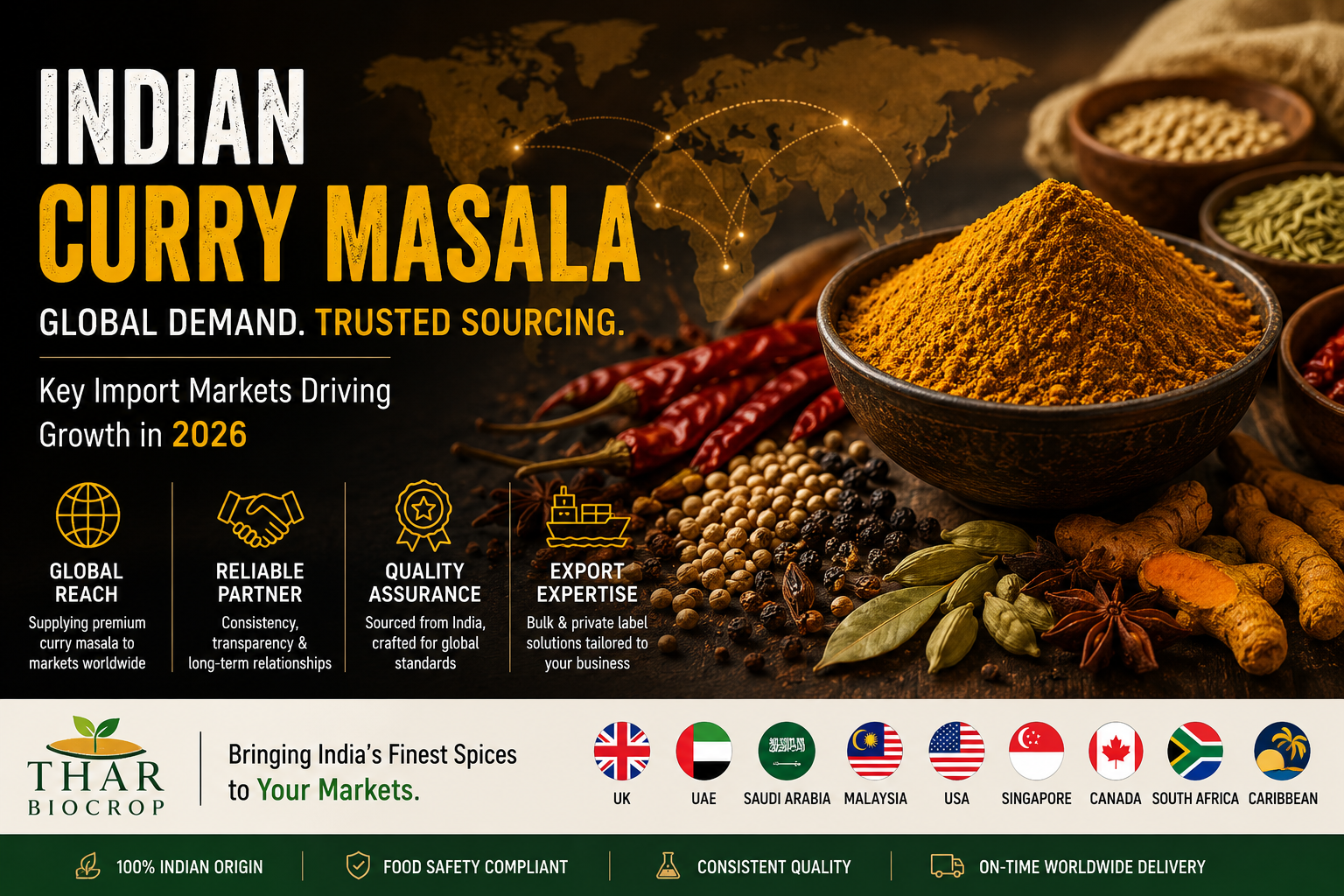
Why Indian Curry Masala Continues to See Strong International Demand Across Retail, Horeca, and Food Manufacturing Segments
Indian Curry Masala Is No Longer Limited to Ethnic Shelves
Over the last decade, Indian curry masala and curry powder categories have expanded far beyond traditional ethnic retail segments.
Today, Indian-origin curry blends are increasingly used across:
- retail spice shelves
- horeca supply chains
- foodservice kitchens
- ready-to-cook products
- marinades and seasonings
- frozen food manufacturing
- meal kits
- private label spice programs
This growing international demand has made India one of the most strategically important sourcing origins for curry masala and blended spice products.
According to the Spices Board of India, India continues to play a central role in the global spice trade across both whole spices and value-added spice blends.
Why Curry Masala Demand Is Expanding Beyond Traditional Indian Cuisine
Indian curry masala is increasingly being used far beyond traditional Indian food applications.
Across multiple international markets, curry blends are now integrated into:
- fusion cuisine
- ready-to-cook meals
- frozen foods
- marinades
- seasoning applications
- meal kits
- quick-service restaurant menus
- convenience food categories.
This expansion has widened demand across both retail and horeca supply chains, particularly in markets where consumers are increasingly experimenting with globally influenced flavors.
As a result, Indian-origin curry powder and blended spice products continue to see growing relevance across food manufacturing, foodservice, and private label categories.
Key Global Markets Importing Curry Masala and Curry Powder from India
United Kingdom
UK is one of the strongest global markets for Indian curry masala.
Demand is supported by:
- large South Asian diaspora
- established curry culture
- retail spice consumption
- restaurant and takeaway ecosystems
- private label ethnic food brands
UK importers often look for:
- consistent flavor profiles
- documentation reliability
- stable supply continuity
- bulk horeca packs
- retail-ready spice blends
United Arab Emirates
UAE continues to be a major trade and redistribution hub for Indian spice blends.
Demand comes from:
- horeca distributors
- retail chains
- repackers
- catering supply networks
- re-export businesses
Dubai also acts as a strategic gateway for:
- GCC markets
- East Africa
- regional food distribution networks.
Saudi Arabia
Saudi Arabia remains an important market for curry powder and blended spice imports.
Demand is supported by:
- large expatriate population
- foodservice growth
- catering demand
- increasing international cuisine consumption
Importers in Saudi Arabia often prioritize:
- consistency
- packaging reliability
- long-term supplier continuity
- stable commercial relationships.
Malaysia
Malaysia is one of the more strategically interesting markets for Indian curry masala.
The market combines:
- Indian-origin culinary influence
- strong spice consumption culture
- horeca demand
- food manufacturing activity
- retail blended spice demand.
Malaysia also offers potential as a Southeast Asian redistribution and sourcing hub.
United States
USA continues to see growing demand for curry powder and Indian spice blends across:
- ethnic retail
- mainstream supermarkets
- private label brands
- meal-kit companies
- seasoning manufacturers
- frozen food categories.
US buyers increasingly prioritize food safety awareness, traceability, packaging consistency, and supplier responsiveness.
Canada
Canada remains an important importer of Indian-origin spice blends, supported by:
- multicultural consumer demand
- South Asian population growth
- horeca expansion
- retail ethnic food categories.
Singapore
Singapore continues to be a commercially important premium food-import market.
Importers often prioritize:
- quality consistency
- professional documentation
- reliable packaging
- operational responsiveness.
Singapore also acts as a strategic regional food trade and redistribution center.
South Africa
South Africa is an important market for Indian curry blends due to:
- established Indian-origin culinary influence
- retail spice demand
- horeca applications
- local curry consumption culture.
Caribbean Markets
Several Caribbean markets import Indian-origin curry powder and spice blends for:
- retail distribution
- horeca supply
- foodservice applications
- local spice repacking.
Markets connected to:
- Trinidad & Tobago
- Guyana
- Guadeloupe
- and wider Caribbean food distribution ecosystems
continue to show long-term relevance for curry masala sourcing.
Why Similar Curry Masala Quotations Can Represent Very Different Products
In international curry masala sourcing, quotations that appear commercially similar on paper can often represent significantly different product categories in terms of formulation, aroma profile, ingredient balance, and intended market positioning.
At first glance, two curry powder quotations may appear comparable on paper while being fundamentally different products in terms of formulation, ingredient quality, aroma profile, and overall composition.
Differences in commercial positioning often emerge from factors such as:
- spice grade selection
- percentage of premium spices used
- oil and aroma strength
- formulation complexity
- use of fillers or carrier bases
- chili quality and heat profile
- turmeric quality
- coriander and cumin ratios
- processing and blending standards
- moisture control
- packaging specifications.
For example, formulations designed for premium retail, horeca, or flavor-focused applications may contain:
- higher percentages of cumin, coriander, black pepper, cardamom, or premium chilies
- cleaner formulations with lower filler usage
- stronger aroma retention
- and more consistent blending standards
will naturally sit in a different commercial category compared to highly price-optimized blends.
At the same time, different import markets and customer segments may prioritize different commercial objectives such as:
- aggressive price positioning
- institutional bulk usage
- or economy retail segments,
while others prioritize:
- flavor depth
- cleaner formulations
- stronger aroma profiles
- horeca suitability
- or premium retail positioning.
As a result, many experienced importers evaluate curry masala not only through price-per-kilogram comparison, but also through:
- composition
- flavor profile
- intended market positioning
- ingredient balance
- consistency
- and long-term product performance.
What Importers Increasingly Evaluate Beyond Pricing
Beyond quotation competitiveness, many importers increasingly evaluate:
- flavor consistency
- moisture control
- packaging reliability
- communication responsiveness
- shipment coordination
- documentation readiness
- long-term supply continuity.
For retail and horeca-focused buyers, operational consistency increasingly becomes commercially important.
The Growing Importance of Private Label Curry Masala
Private label curry masala and custom spice blends continue to grow across multiple international markets.
Retailers and food brands increasingly explore:
- customized formulations
- region-specific flavor profiles
- horeca-focused blends
- institutional packaging
- retail-ready private label programs.
As a result, suppliers capable of supporting:
- consistency
- responsive communication
- scalable supply
- documentation readiness
- and long-term coordination
are increasingly valued.
Why India Continues to Remain a Strategic Curry Masala Origin
India remains globally competitive in curry masala sourcing because of:
- spice availability
- blending expertise
- established processing infrastructure
- export experience across multiple markets.
At the same time, international buyers increasingly expect suppliers to combine commercial competitiveness with operational professionalism and long-term consistency.
Exploring Curry Masala Sourcing from India?
Businesses looking to explore:
- bulk curry powder sourcing
- horeca curry masala supply
- private label spice blends
- Indian curry masala export partnerships
- wholesale spice sourcing from India
We focus on supporting long-term sourcing relationships through:
- responsive communication
- operational coordination
- realistic commercial discussions
- and supply continuity.
Final Thought
Global demand for Indian curry masala continues to expand across retail, horeca, foodservice, and manufacturing channels.
As international sourcing environments become more operationally demanding, buyers increasingly evaluate suppliers not only on pricing, but also on consistency, communication, reliability, and long-term continuity.
For businesses exploring curry masala sourcing from India, these factors are becoming increasingly important in supplier evaluation and long-term procurement decisions.