
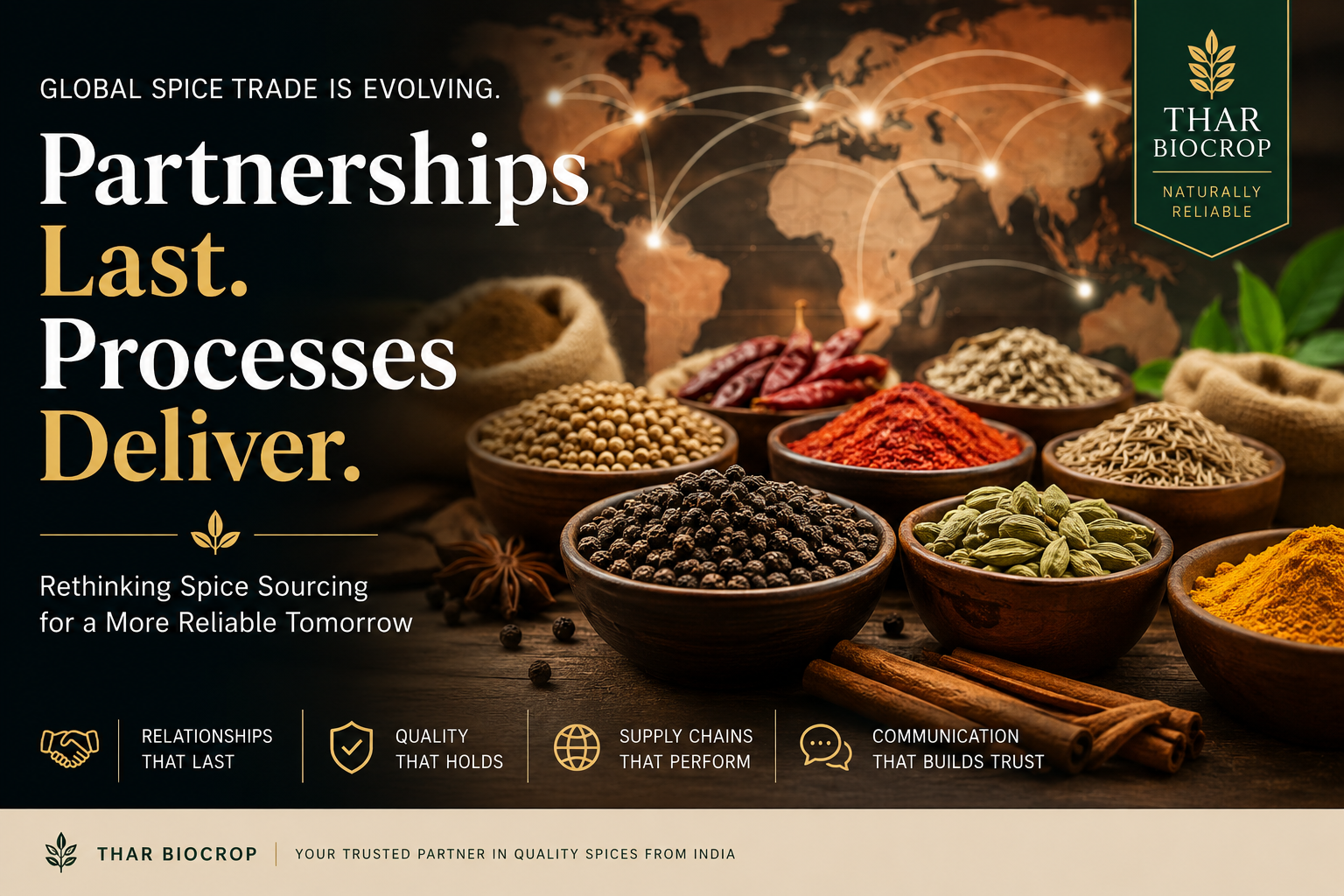
Why the Future of Spice Procurement Is No Longer About Price Alone
The Global Spice Trade Is Evolving Under Pressure
Over the last few years, global spice sourcing has become significantly more complex.
Importers today are navigating:
- freight volatility
- shifting crop conditions
- tighter compliance expectations
- documentation scrutiny
- container unpredictability
- fluctuating raw material availability
- changing customer expectations in destination markets
In this environment, sourcing decisions increasingly affect not just procurement economics, but operational continuity itself.
For many buyers, supplier evaluation today extends beyond:
- price per kg
- freight advantage
- immediate availability
and increasingly includes questions around:
- consistency
- responsiveness
- shipment reliability
- communication quality
- documentation discipline
- long-term supply continuity
This shift is gradually reshaping how serious importers evaluate sourcing relationships.
Why Supplier Stability Has Become Increasingly Important
Across Europe, the Middle East, North America, Africa, and the Caribbean, many importers are becoming more selective about supplier continuity.
Not necessarily because pricing has become less important.
But because operational disruption has become more expensive.
Even relatively small issues can create downstream impact:
- shipment inconsistency
- moisture variation
- delayed dispatches
- unclear communication during shipment windows
- documentation mismatches
- reactive rather than proactive coordination
For importers supplying retail, horeca, foodservice, repacking, or distribution channels, continuity increasingly matters alongside commercial competitiveness.
As a result, many buyers today evaluate suppliers not only commercially, but operationally.
They need:
- a sourcing partner
- a communication partner
- a risk management partner
- a continuity partner
Especially when sourcing from origin countries like India.
Operational Concerns Many Importers Quietly Prioritize
Across conversations with importers, distributors, sourcing intermediaries, and procurement stakeholders across regions, certain operational concerns repeatedly emerge.
Not publicly. But privately.
1. “Will the supplier remain consistent after the first shipment?”
This is one of the biggest concerns.
Many suppliers are highly responsive before order confirmation. After booking:
- communication slows
- accountability weakens
- timelines shift
- quality consistency changes
This destroys trust.
2. “Will the supplier disappear during operational pressure?”
A surprising number of buyers have experienced:
- delayed responses during shipment windows
- evasive communication
- sudden silence
- unexpected commercial changes
Importers increasingly value suppliers who stay communicative during difficult situations.
3. “Can the supplier scale with us?”
Many importers are not only buying current volume. They are testing future scalability.
A buyer sourcing 1 container today may internally be evaluating:
- 5 containers
- regional expansion
- retail distribution growth
- private label scaling
The supplier’s professionalism during early interactions influences these decisions heavily.
The Rise of Relationship-Driven Procurement
One of the least discussed changes in global trade is this:
The world is quietly moving from purely transactional procurement toward relationship-supported procurement.
Even large buyers increasingly value:
- communication maturity
- reliability under uncertainty
- long-term supplier stability
- relationship continuity
- supplier seriousness
Because supply chains today are more fragile than most people realize.
And when disruption happens, buyers prioritize suppliers they trust.
Not merely suppliers with slightly lower pricing.
India’s Position in the Global Spice Industry
India continues to remain one of the world’s most strategically important spice origins. According to the Spices Board of India, the country continues to play a central role in global spice production and exports across multiple categories.
Particularly for:
- cumin
- coriander
- turmeric
- fennel
- chili
- black pepper
- fenugreek
- blended spice requirements
However, the modern global buyer increasingly expects more than simply “India origin product.”
Today’s buyer increasingly evaluates:
- supplier maturity
- communication quality
- transparency
- consistency
- documentation readiness
- long-term reliability
The export business is no longer only about sourcing product.
It is about managing trust.
Why Communication Has Become a Competitive Advantage
One area that has become increasingly important in international trade environments is communication consistency.
But communication quality has become one of the biggest hidden differentiators in international trade.
Buyers today are overwhelmed with:
- fragmented suppliers
- unclear responses
- delayed updates
- vague commitments
- inconsistent professionalism
A supplier who communicates:
- clearly
- honestly
- professionally
- consistently
already differentiates themselves significantly.
Especially in international B2B environments.
Building Long-Term Reliability in Global Spice Trade
In international spice sourcing, long-term business relationships are rarely built on pricing alone.
Over time, buyers naturally gravitate toward suppliers who are able to maintain:
- consistency across shipments
- responsive communication
- operational clarity
- documentation discipline
- realistic commitments
- continuity during volatile market conditions
Particularly in the spice industry, where supply chains are influenced by:
- crop variations
- freight fluctuations
- changing regulatory expectations
- seasonal availability
- and market volatility,
reliability itself increasingly becomes part of the commercial value equation.
For many importers and distributors, this is not simply a procurement consideration anymore — it is also a continuity and risk-management consideration.
What Experienced Buyers Often Evaluate During Early Supplier Discussions
In many sourcing discussions, experienced buyers are quietly assessing factors beyond the quotation itself.
For example:
- Does the supplier communicate clearly when specifications change?
- Are responses commercially realistic or overly aggressive?
- Does the supplier understand freight and operational realities?
- Can the supplier maintain consistency if volumes scale?
- Is the supplier relationship likely to remain stable beyond the first shipment?
Often, these evaluations begin long before the first container is booked.
In practical terms, early communication quality frequently becomes part of the supplier evaluation process itself.
The Real Cost of Constant Supplier Switching
Many buyers continuously chase short-term pricing advantage.
But constant supplier switching creates hidden costs:
- quality inconsistency
- communication reset cycles
- operational learning curves
- shipment unpredictability
- compliance risk
- damaged customer trust downstream
At scale, these costs become larger than the pricing savings themselves.
Why We Believe the Industry Needs a Different Approach
At urlThar BioCrophttps://tharbiocrop.com, we believe the future of spice exports must evolve beyond purely transactional trading.
The global market increasingly requires:
- reliability
- responsiveness
- relationship continuity
- sourcing intelligence
- operational maturity
- realistic communication
The businesses that understand this shift early will build stronger long-term supply ecosystems.
The Next Era of Spice Trade
The spice industry is entering a new phase.
A phase where:
- buyers want fewer but better supplier relationships
- trust compounds over time
- communication matters
- professionalism matters
- consistency matters
- resilience matters
And suppliers who understand this evolution will become increasingly valuable.
Final Thought
The global spice trade has always been relationship-driven to some degree.
What appears to be changing today is the depth of operational expectation surrounding those relationships.
For serious importers, sourcing is no longer only about finding available product. It is increasingly about building dependable supply continuity in a volatile environment.
And for suppliers, long-term credibility is increasingly built through:
- consistency
- responsiveness
- operational clarity
- realistic communication
- and reliability over time.
In an industry shaped by seasonality, freight dynamics, crop variability, and changing compliance expectations, these factors increasingly become commercially meaningful.
Not just operationally useful.
For businesses evaluating long-term sourcing partnerships, consistency in communication, documentation readiness, and supply continuity increasingly become as important as pricing itself.
Exploring Spice Sourcing from India?
Whether your business is evaluating alternate sourcing partners, diversifying supply risk, or exploring long-term procurement relationships from India, the evaluation process increasingly goes beyond pricing alone.
At Thar BioCrop, our focus is on supporting professional sourcing relationships through:
- responsive communication
- realistic commercial discussions
- operational coordination
- and long-term consistency.
Looking for a Reliable India Spice Sourcing Partner?
If your business is looking to build long-term sourcing relationships from India for:
- cumin
- coriander
- fennel
- turmeric
- chili
- blended spice requirements
- bulk spice sourcing
- private label support
We believe in building long-term sourcing relationships based on:
- clarity
- consistency
- communication
- and operational trust.