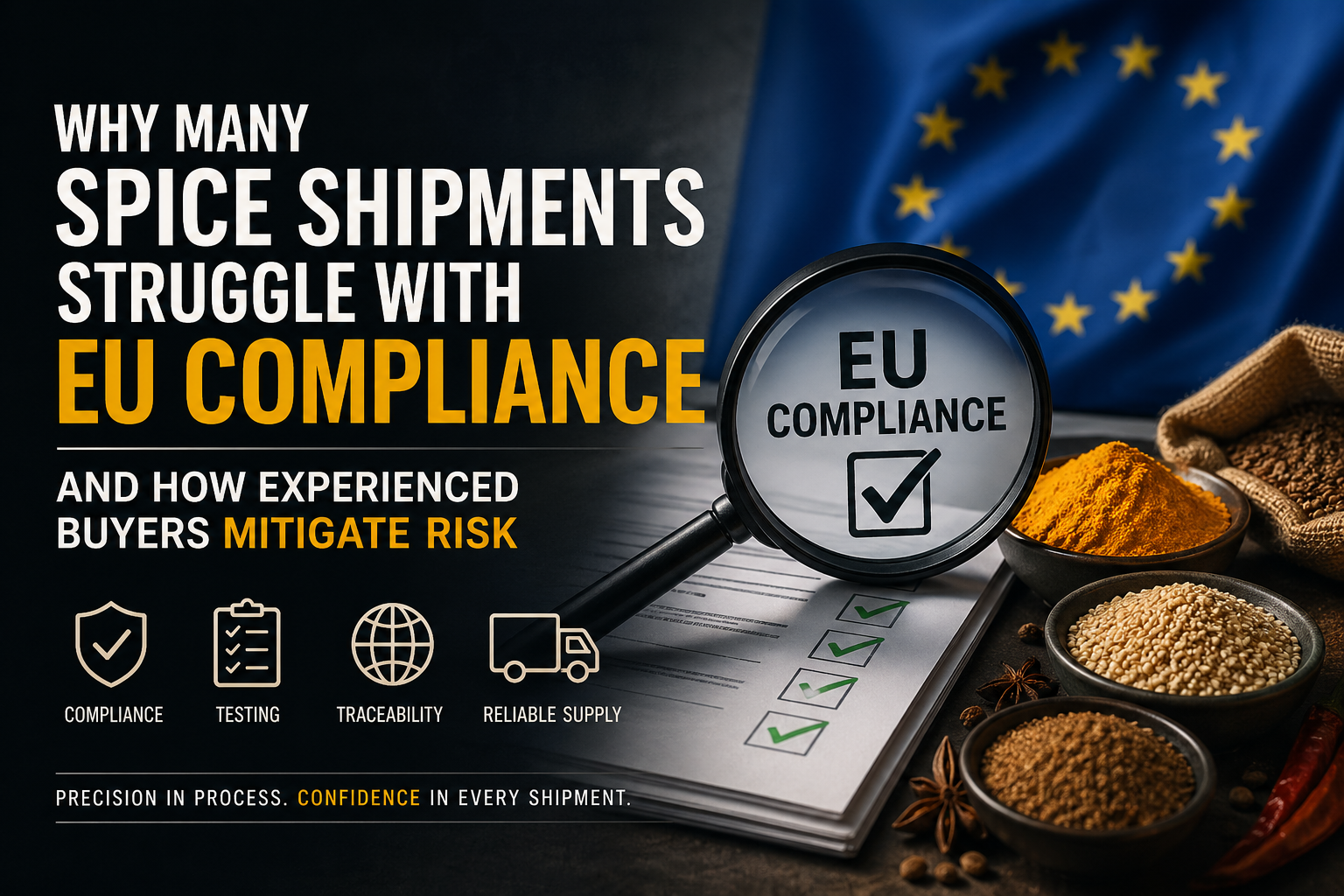
🌍 It Rarely Fails on Price. It Fails on Precision.
Most spice shipments to Europe don’t fail because they are low quality.
They fail because they are not precisely aligned.
Specifications are shared.
Samples are approved.
Pricing is competitive.
Yet shipments still face delays, rejections, or unexpected issues.
Because in the EU, compliance is not broad.
It is parameter-specific, process-driven, and unforgiving of variation.
🔎 What Defines EU-Compliant Spices in Practice
For buyers importing into Europe, compliance typically requires:
- Alignment with EU pesticide MRL regulations (EC 396/2005)
- Control of contaminants such as aflatoxins and ochratoxin
- Microbiological safety (Salmonella-free requirement)
- Use of ETO-free processing and steam sterilized spices
- Batch-level traceability and consistency
These are not formalities.
They are shipment-critical checkpoints.
⚠️ The Difference Between “Meeting Spec” and “Holding Spec”
On paper, most suppliers meet specifications.
But experienced buyers distinguish between:
- products that fall within limits
- and products that are engineered to stay within limits
For example:
- Moisture may be within range
- Microbiology may pass at dispatch
But without process control, these can shift during transit.
👉 The real question is not compliance at origin.
👉 It is compliance at arrival.
🔍 What Experienced Buyers Actually Read in a Spec Sheet
They don’t read everything.
They read signals.
1. The “Hero Parameter” — and Its Context
Every product has a parameter that appears critical.
But serious buyers never rely on it alone.
For example:
- In turmeric, curcuminoid levels matter — but color consistency, processing conditions, and batch variation often define real-world performance
- In psyllium, purity is expected — but swelling behavior determines functional performance
- In oil seeds, oil content matters — but free fatty acid levels reflect handling quality
👉 A number defines the level.
👉 Context defines the reliability.
2. Microbiology Is Binary — But Stability Is Not
Most suppliers can meet:
- Salmonella: absent in 25g
- E. coli: absent
But experienced buyers ask:
👉 How is this achieved?
Because:
- Natural microbial load varies
- Transit conditions impact stability
- Blended products behave differently
This is why steam sterilized spices for EU markets are often required—not just to pass tests, but to ensure consistency.
3. Process Compliance Is No Longer Optional
EU buyers increasingly evaluate processing method, not just test results.
This is especially relevant for:
- ETO-free spices
- steam sterilized spices required for EU imports
For example:
- Ethylene Oxide (ETO): not acceptable
- Irradiation: restricted
- Steam sterilization: commonly expected
These expectations align with frameworks guided by
European Food Safety Authority
👉 A product can pass microbiology.
👉 But still fail on process declaration.
4. Contaminants: The Invisible Gatekeepers
The most critical failures are often invisible.
EU limits are strict:
- Aflatoxins (μg/kg range)
- Ochratoxin A
- Heavy metals (Pb, Cd, Hg)
- PAHs linked to drying methods
- Pesticides under EU MRL regulations (EC 396/2005)
👉 These are not quality variations.
👉 They are regulatory thresholds.
5. Where Supply Chain Discipline Becomes Visible
Some products quietly reveal how controlled a supply chain really is.
Take sesame as an example.
On paper:
- High purity
- Strong oil content
- Low foreign matter
But experienced buyers look deeper:
- consistency of cleaning and sorting
- handling quality reflected in stability parameters
- absence of extraneous material
👉 In such products, contamination risk is directly linked to process discipline
A shipment can meet spec once.
Control means it meets it every time.
6. Functional Performance Matters More Than Appearance
In certain categories, appearance tells very little.
What matters is performance.
For example:
- swelling behavior in functional fibers
- consistency in application
👉 These are not visual parameters.
👉 They define end-use reliability.
7. Where Blends Expose Real Capability
Single-origin products are easier to control.
Blends are not.
In blended products:
- Multiple raw materials
- Different moisture levels
- Combined microbiological loads
- Particle size control
- Restrictions on additives
Each component may meet specification.
But the system may not.
👉 Compliance in blends is not about ingredients.
👉 It is about process control across the system.
🧠 What Experienced Buyers Do Differently
They don’t ask:
❌ “Is this within spec?”
They ask:
✔ “Is this controlled at source?”
✔ “Is the process repeatable?”
✔ “Will this remain compliant at arrival?”
🚀 The Shift in EU Spice Procurement
The market has evolved.
From:
- price-driven sourcing
- sample-based validation
To:
- system-level evaluation
- process-led sourcing
Because in EU trade:
👉 consistency is not assumed — it is verified
🌱 A Note from Thar BioCrop
At Thar BioCrop, we don’t approach specifications as a checklist.
We approach them as a controlled system.
Our focus:
- aligning sourcing with EU expectations
- understanding which parameters truly impact performance
- ensuring process compliance (including sterilization protocols where required)
- maintaining consistency across shipments
👉 Learn more about our approach to
EU-compliant spice sourcing from India:
Thar BioCrop
Because for serious buyers, the real question is simple:
👉 Will this work every time?
🤝 Let’s Connect
If your sourcing priorities are shifting toward reliability and compliance:
📩 info@tharbiocrop.com
🌐 www.tharbiocrop.com