In the current fiscal landscape, the mandate for U.S. spice sourcing has shifted from “lowest cost” to “verified resilience.” As the FDA intensifies its digital mandates and specific tariff exemptions favor Indian origin, the role of the Global Sourcing Strategist has never been more critical.
For brands looking to stabilize their 2026 supply chain, India has emerged as a high-security corridor. Here is a breakdown of the strategic factors currently driving boardroom decisions.
1. The Financial Hook: 2026 Tariff Exemptions
Cost-efficiency remains a primary KPI for every Sourcing Head. In late 2025, the U.S. government implemented significant reciprocal tariffs on various global goods. However, to protect American consumers from grocery inflation, the administration issued a comprehensive exemption for Indian spices.
- The Advantage: Categories like Turmeric, Cumin, Ginger, and Cardamom are currently exempt from these high duties.
- The Impact: This keeps Indian spices roughly 25–30% more cost-effective than other origins. For U.S. procurement teams, India is now the most strategic source for bulk high-purity ingredients.
2. FSMA 204: The 24-Hour Digital Mandate
In 2026, a shipment is only as good as its data. Under the FDA’s Food Traceability Final Rule (FSMA 204), “Key Data Elements” (KDEs) are now mandatory for every “Critical Tracking Event.”
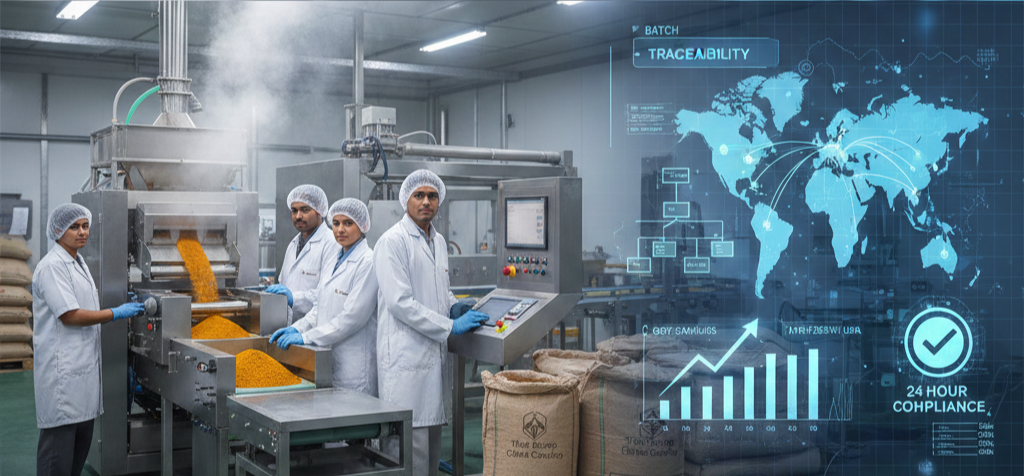
- The Rule: Importers must be able to provide an electronic, sortable spreadsheet of traceability data to the FDA within 24 hours of a request.
- The Solution: Sophisticated Indian partners have transitioned to cloud-based batch tracking. This ensures that every lot of spice has a digital “pedigree” from the farm cluster to the U.S. port of entry.
Strategic Note: Elite buyers are prioritizing partners with integrated transparency to eliminate the risk of port detentions and supply chain friction.
3. Precision Safety: Beyond Conventional Standards
The U.S. market has officially moved toward a “Zero-Tolerance” policy for chemical residues and pathogens. To meet these standards, the 2026 sourcing model relies on two pillars:
- Steam Sterilization: This is the gold standard for microbial safety. It effectively eliminates pathogens like Salmonella while preserving the essential oils and flavor profiles that U.S. consumers expect.
- IPM Farm Clusters: Integrated Pest Management (IPM) ensures that crops are grown within strict Maximum Residue Limits (MRLs). By sourcing from monitored clusters, importers avoid the “Import Alerts” that have plagued unorganized suppliers.
4. Operational Stability in a Volatile Market
Sourcing in 2026 requires more than a price list; it requires a compliance portfolio. The most successful U.S. brands are moving away from fragmented brokerage buys and toward direct, audit-ready relationships in India. These partnerships offer:
- Production-Ready Ingredients: Sized and graded to your manufacturing specs.
- Digital Traceability: Instant access to COAs and tracking data.
- ESG Alignment: Sustainable packaging and ethical farm-level sourcing.
Secure Your 2026 Supply Chain
The U.S. market has a high appetite for Indian spices but zero tolerance for risk. Success in 2026 belongs to procurement teams that prioritize compliance as a product feature. By aligning with a tech-forward Indian exporter, you can leverage unmatched scale while meeting the world’s strictest safety standards.
Ready to modernize your spice sourcing? Contact our compliance team today for a full audit of our FSMA-ready supply chain and secure your 2026 inventory at tariff-exempt rates.